
A gentle north-to-south route · map not to scale
At a glance
- Pace
- Two or three nights per base, rest afternoons
- Moving days
- No more than one long transfer every two or three days
- Best for
- Parents in their seventies and three-generation families
- Budget
- From 140 USD per person per day at 4★ (2 travellers); domestic flights extra
The short answer
Vietnam works well for parents in their seventies on a private trip. My checklist: two or three nights per place, a rest day every four or five days, sightseeing in cooler mornings, a doctor visit at least a month ahead, extra medication, travel and evacuation insurance, and hotels and ships chosen to keep walking and stairs to a minimum.
Many of the long trips our team plans are for travellers in their sixties and seventies, and sometimes the person planning is a son or daughter booking for their parents. Vietnam suits older travellers well on a private trip, because a car, a driver and a guide remove most of the hard parts. What decides whether the trip feels easy is the planning: pace, transfers, heat and a few health preparations. This is the checklist I work through before I approve such a route.
Planning a trip for elderly parents in Vietnam: the four questions I ask first
Before I draw a route, I ask four things: how far each parent walks comfortably, how they manage stairs, how they cope with heat, and how well they sleep after a long day. The answers shape everything else. Vietnam’s national tourism site describes the country as one of the safest for travellers, and Hanoi, Da Nang and Ho Chi Minh City have public and private hospitals with English-speaking staff. The real challenges are heat, long transfer days, uneven ground and early starts, and all four can be planned around when the timing is yours rather than a group’s.
Planning a trip for elderly parents in Vietnam: the pace checklist
- Two or three nights in each place, and no more than one long transfer every few days.
- A rest day every four or five days, with the car on call but nothing scheduled. On a 14-day trip that usually means one free day in Hoi An and one by the sea.
- Sightseeing in the morning, before the heat builds, with a long lunch and a rest in the afternoon.
- No dawn arrivals unless wanted. Standard check-in is usually 2 pm and early check-in is not included by default, so if the flight lands at sunrise I add it to the quote.
- Fewer stops, more depth. A route built around rest days, like the one in three weeks in Vietnam, is the shape I recommend most for parents: Hanoi, the bay, Ninh Binh, a long stay in Hoi An and a beach at the end.
Our guides also adapt within the day. A cyclo ride through Hanoi’s Old Quarter covers a lot of ground without much walking. On foot, take care with traffic: the US CDC reminds walkers that people on foot do not always have right of way.
Sleeper train, daytime train, car or flight?
Getting between regions is the most tiring part of a Vietnam trip. This is how I compare the options for older travellers.
| Option | Example | Good for | Watch out for |
|---|---|---|---|
| Regular night train | Hanoi to Lao Cai for Sapa | Saving a hotel night | Arrives around 6 am; the return reaches Hanoi around 5 am |
| SJourney luxury sleeper train | Hanoi to Ho Chi Minh City with stops | Seeing the country without packing every two days | Scheduled Wednesday departures; limited dates; arrives in Saigon around 5 am |
| The Vietage daytime carriage | Da Nang to Quy Nhon, Quy Nhon to Nha Trang | A relaxed day with a meal at your seat | About six and five hours; seats reserved at least three days ahead |
| Private car | Hanoi to Ha Long (about 2.5 hours), Hanoi to Sapa (about 4 hours) | Door-to-door, stops whenever you like | Long days if combined with sightseeing |
| Domestic flight | Hanoi to Da Nang or Ho Chi Minh City | Speed over long distances | Airport time; quoted separately |
For most parents in their seventies I drive to Sapa rather than use the night train, and I use The Vietage to replace a flight in the centre: it is a private 12-seat carriage, and the driver meets you at each station, so there is no luggage to carry beyond the platform. If the whole-country train appeals, see Metta Voyage’s 13-day luxury tour with the SJourney train for the current from-price.

The health checklist: what the CDC and WHO advise
See a doctor or travel clinic well ahead: the US CDC says at least a month before the trip, and Vietnam’s tourism authority suggests two months. Points the CDC lists for Vietnam include:
- Routine vaccines up to date, which for older adults includes flu and shingles.
- Hepatitis A and hepatitis B recommended for unvaccinated travellers, and typhoid for most travellers.
- Japanese encephalitis to consider if you will spend time in rural areas; not recommended for short urban trips.
- Malaria: transmission is in rural areas only, with none in Hanoi, Hai Phong, Da Nang, Nha Trang, Quy Nhon or Ho Chi Minh City. Ask your doctor whether your route needs tablets.
Medication. Bring all the medicines you need, plus extra in case of travel delays, as the CDC advises. Vietnam’s tourism authority notes that some medicines are hard to find in the country, and recommends carrying a doctor’s letter describing any condition that needs particular attention. The CDC also suggests carrying a card with your blood type, chronic conditions, serious allergies and the generic names of your medicines, and checking with Vietnam’s embassy that your prescriptions are legal to bring in.
Travel insurance. Buy it before you go, as the tourism authority advises, and consider medical evacuation cover: the CDC notes that trauma care centres are uncommon outside urban areas. Check that the policy covers your parents’ ages and any existing conditions.
Heat, sun and mosquitoes
Heat is what our guides watch most closely. The WHO notes that heat-related deaths among people over 65 rose by about 85% between 2000–2004 and 2017–2021, and advises drinking water regularly, about a cup an hour and at least two to three litres a day. The CDC advises limiting physical activity in high temperatures and seeking shade between 10 am and 4 pm.
In practice our guides carry water in the car, plan indoor stops for the middle of the day, and shorten a visit when it gets hot. The month matters too: how I choose the month shows when each region is coolest. For mosquitoes, the WHO notes that the species that spread dengue bite during the day. Long sleeves and a repellent containing DEET, picaridin or IR3535 are the simple defence.
Stairs, boats and uneven ground
Some of Vietnam’s best moments involve steps or small boats: cave visits on the bay, rowing boats into lagoons, the temple grounds at My Son. None of them is compulsory. Our guide explains in advance what each visit involves, and anyone can stay on deck or in the shade while others go ahead.
On the bay I recommend two nights rather than one. With one night, almost half the cruise is boarding and disembarking; with two, there is a full, slow day on the water. Heritage Line Ylang suits older couples: ten balcony suites, at most 20 guests, and a program of tai chi, spa and gentle shore outings. What I check before booking a cabin covers the ship choice.

Mistakes I see most often
- Planning the trip the children would take. A route that suits a 45-year-old with a full day of sightseeing is usually one stop too many for parents in their seventies.
- Arriving after an overnight flight and starting the tour the same day. The first day should be a hotel, a short walk and an early dinner.
- Booking a cliffside or hilltop room without asking about access. Some beautiful resorts are spread over slopes; ask how you reach the room before you choose it.
- Leaving insurance to the last week. Policies with age limits or condition exclusions take time to compare.
- Packing medication in the hold. Keep it in hand luggage, with the doctor’s letter.
Where to stay: hotels that make it easier
- Hanoi: Fairmont Hanoi is a short walk from Hoan Kiem Lake, and its wellness floor has a bathhouse and a 20-metre lap pool, a gentle way to recover from the long flight.
- Near Ha Long: Hilton Quang Hanh Onsen Resort, about 30 minutes from Ha Long, has a private hot-spring bath in every villa and room; one night there breaks up the drive before a cruise.
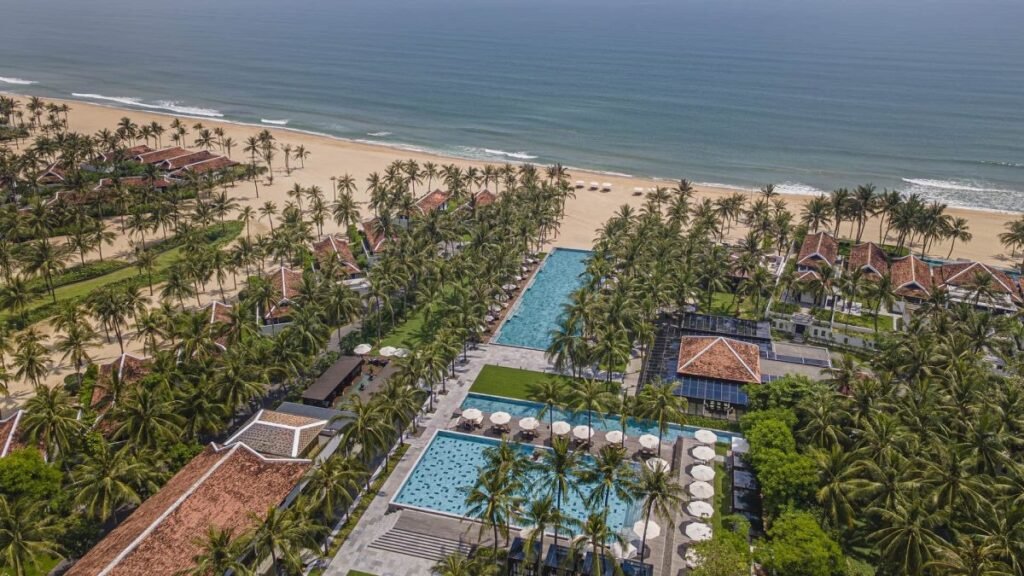
- Hoi An: Four Seasons Resort The Nam Hai has 100 villas along a kilometre of beach, so I ask for a villa close to the main facilities; there is an adults-only quiet pool alongside the family pool.
- Da Nang: InterContinental Danang Sun Peninsula Resort is built up a cliff, with the Nam Tram funicular linking the beach, restaurants and hilltop rooms, worth knowing before you choose a room. TIA Wellness Resort is beachfront and fifteen minutes from the airport, with two spa treatments per person each night on its Wellness Inclusive stay.
- Hue and Ho Chi Minh City: we choose a central 4–5★ hotel with a lift and name it in your quote. More in how I choose 4–5★ hotels.
Responsible travel at an easy pace
A slower trip is usually a lighter one: fewer flights, longer stays and more money spent with local guides, drivers, restaurants and craft workshops. We replace flights with trains or cars where the timing works. A village visit with a guide who knows the families, such as Cat Cat near Sapa or the Mekong orchards, gives more back than a crowded viewpoint.
What it costs
Our private trips start from 140 USD per person per day, confirmed in your private quote, based on two travellers sharing 4★ hotels with a private guide and driver. A 14-day trip is from 1,960 USD per person; groups of four save 5% and groups of six save 8%, which often applies when parents travel with their adult children. Top-tier resorts and ships, such as The Nam Hai, start from 350 USD per person per day and are quoted individually. Domestic flights are quoted separately. Booking needs a 30% deposit (balance 45 days before arrival) and a non-refundable 100 USD holding fee per traveller (kept even if you cancel early); card payments carry a 3.5% fee. See how I price 10, 14 and 21 days for worked examples.
For ready-made starting points, see Metta Voyage’s 10-day in-style tour for couples and the 14-day family tour, which ends with three nights on the beach; both can be slowed down for older travellers.
Sample itinerary, price from and a quote
If you want to see this advice turned into a bookable plan, start with a gently paced two-week private tour: Vietnam Tour in Two Weeks: My Private 14-Day Route and Prices. It has a day-by-day sample itinerary, the hotels I would use and the price logic.
As a guide, a private trip of 14 days starts from 1,960 USD per person (14 days × 140 USD, 2 travellers sharing, 4★ hotels, private guide and driver), about 1,862 USD per person for a group of four and 1,803 USD for a group of six, confirmed in your written quote. Domestic flights are not included and are quoted separately; 5★ and luxury stays are quoted individually.
Request a quote for this route
Sources
Vaccines, malaria, medication, insurance, heat and road safety: US CDC – Travelers’ Health: Vietnam. Heat and older people: World Health Organization – Heat and health fact sheet. Dengue: World Health Organization – Dengue fact sheet. Insurance, medicines, hospitals: Vietnam National Authority of Tourism – Health and safety. Hotel, ship and train details: Metta Voyage luxury collection pages linked above and the operators’ announcements they cite.
Questions we are often asked
Is Vietnam suitable for travellers in their seventies?
Yes, on a private trip with a slower pace. A car and guide remove most of the effort, and we plan around heat, long transfers and steps.
What vaccines do older travellers need for Vietnam?
The US CDC recommends routine vaccines, including flu and shingles, plus hepatitis A, hepatitis B and typhoid for most travellers. Ask your doctor at least a month before you go.
Should elderly parents take the night train or fly?
For most older travellers we prefer a private car, a daytime train such as The Vietage, or a short flight. Regular night trains arrive very early in the morning.
Do we need travel insurance for Vietnam?
Yes. Vietnam's tourism authority advises buying insurance before you go, and the CDC suggests considering medical evacuation cover because trauma care centres are uncommon outside cities.
Is a Ha Long Bay cruise difficult with limited mobility?
Cave visits and small-boat outings involve steps, but none is compulsory. We suggest two nights on a small ship so the pace stays relaxed.
David — for The Metta Voyage team. Checked against our itineraries and the sources above on 11 November 2026.